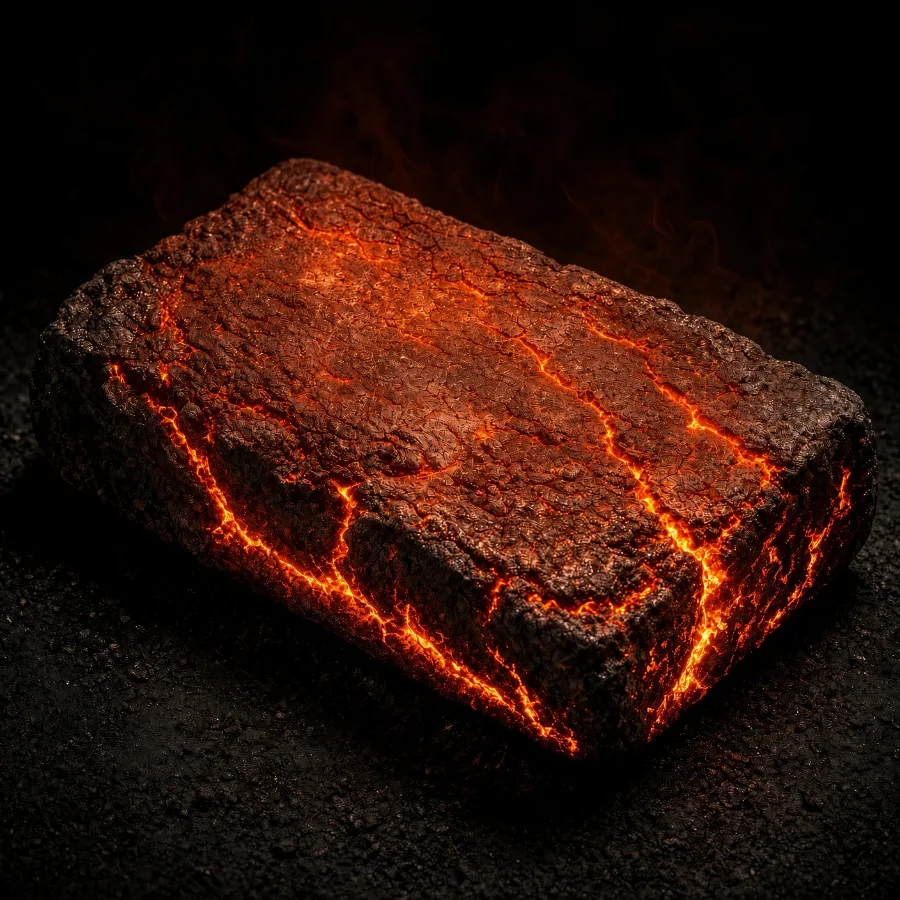
Tier 1
×1What a mint usually gives you.
Rigs dig for $ORE and Silicon. Mint one and it rolls twice — a tier, then a quality within it, and the good ones are rare. 70% of what you paid goes straight into the pool that pays every rig. Rigs wear out. Silicon is what takes you deeper.

Buy a mining rig, and find out how good it is. It pays you a share of the pool every week and mines Silicon at the same time. It wears out over twenty weeks and nothing repairs it — but five worn rigs plus the Silicon they mined fold into one much bigger rig, at full condition.
Most of what a rig earns is paid by people minting rigs. 70% of every mint goes into the pool; a trading venue’s revenue tops it up. So it is largely players paying players, and if minting stops the pool shrinks to the venue’s share alone. That is the honest description and it is the one this page uses.
A rig costs about 20 USDC. 14 of that funds the pool and 6 the treasury. Left to die, a rig returns roughly that 14 back — the pool share arriving exactly where it should, and less than you paid. Combining is how you beat that.
A rig runs 20 weeks, then stops earning for good. There is nothing to repair and nothing to top up. Five rigs and the Silicon they mined fold into one rig of the next tier at full condition, and that is the only way to keep going.
Each week you get your share of that week’s pool. Share means your rig’s size against every live rig’s size added together — so it falls as more rigs join, and it can never exceed what is actually in the pool.
Two names to carry the rest of the page: the reward is $ORE and the progression currency is Silicon, which your rigs mine and combining spends. There is no third thing to buy, hold or manage.
The contract is written and its test suite passes. It is not deployed, not audited, and no Silicon has been issued. Nothing on this page is live yet, and this notice comes down when that changes rather than quietly staying true.
Four steps, and each one feeds the next. Minting pays the pool, the pool pays the rigs, the rigs decay and mine Silicon, and the Silicon is what buys the way up.
A tier-1 rig costs about 20 USDC. 70% of it is converted to $ORE and funded into the epoch pool; the other 30% goes to the treasury. Neither share ever touches this contract — both transfer straight out of your wallet.
the tier roll
88.5%
weight 1
10%
weight 6
1.5%
weight 36
then a quality, within that tier
0.60× – 0.90×
55%
1.00× – 1.20×
33%
1.30× – 1.50×
10%
1.60×
2%
Both multiply the rig’s weight, so they multiply both what it earns from the pool and what it mines in Silicon. Both are fixed for the rig’s life — a rig does not get luckier — and combining takes the average of the five qualities it consumes, so luck carries up the ladder but one lucky rig cannot carry four poor ones.
A mint can never exceed tier 3. The odds are low on purpose: a tier 2 costs five rigs to combine, and rolling for one at better than 20% odds would make combining pointless. At 10% a rolled tier 2 costs about twice a combined one, so combining stays the sensible route and a rolled tier stays a windfall.
Because a roll decided in the same call that pays for it is a free reroll. Anyone can call from a contract, look at what they got, and revert if it is poor — the payment unwinds with it and only the gas is spent. Every good rig in the pit would belong to whoever automated that first.
So the first transaction takes the money and records the block; the second resolves the roll against a blockhash from after that block, which did not exist when the money moved. Nothing to grind, because by the time the seed exists the payment is already final.
Anyone can send the second transaction, not just you. That is what makes it work rather than merely simple: if only you could reveal, you would compute your own outcome and never reveal a bad one. Miss the window entirely and you still get the rig, at the worst quality on the table — never a loss of money, only of the roll.
The limit, said plainly. The seed is a block hash, and block hashes are chosen by whoever produces the block. That stops players grinding, retrying or predicting; it does not stop the chain itself. What bounds it is the size of the prize. A proper fix is a verifiable random function, and Arc does not have one worth relying on yet.
In aggregate, players receive the pool share and not the whole fee. At 70%, the player base gets back 70% of everything minted, plus all of the venue revenue on top. A rig left to die returns about 14 USDC on its 20 — which is that 70%, landing exactly where it should.
The floor is the promise, not the 70%. The share is settable because the split is a live business decision; MIN_MINT_POOL_SHARE_BPS is a compiled-in constant at 50%, so nobody can ever route less than half of what you and everyone after you pays into the pool you are earning from.
Raising the share is better for you, not worse. Worth knowing before anyone tunes it: a higher share means more of every mint reaches players and less reaches the treasury. “Less redistributive” and “better for players” point in opposite directions here.
The way in. A mint rolls a tier — 1, or rarely 2 or 3 — and then a quality within it. Two transactions, because a roll settled in the call that pays for it would be a free reroll.
$ORE divides by every live rig, so more rigs means less each. Silicon divides by nothing — progress is yours, yield is contested.
A rig runs 20 weeks and then dies. Nothing repairs it, so standing still is the one move you do not have.
One rig of the next tier at full condition — six times the weight of one, from five, and a whole life again. The only renewal there is.
Everything on this page is measured in epochs, so it is worth being exact. An epoch is seven days. Your rig loses 500 of its 10,000 condition points each one, and earns a share of whatever $ORE was put into that epoch’s pool.
Boundaries fall at GENESIS + n × 7 days, where GENESIS is the moment the contract is deployed. They are a fixed UTC clock rather than a calendar day, and the exact time is not knowable until deploy — it will be published here once it is.
The pool is not bought at the boundary. The buy-back is permissionless and runs whenever anyone calls it, so $ORE flows into an epoch’s pool continuously through the week. Whatever is in poolAt[e] when epoch e closes is what epoch e pays.
Nothing is sent to you at the boundary either. The contract closes out the total weight of the finished epoch, and your share of it accrues to your rig. You collect it whenever you want by claiming — there is no deadline and nothing expires.
Revenue is not period-matched. Fees earned during one epoch may reach the pool during the next, because collecting them from the launchpad is its own permissionless call on its own schedule. Over any stretch longer than a week this washes out; within a single week it means an epoch’s pool is not exactly that week’s trading.
Mined by your rigs, every epoch they are alive. Non-transferable, no market, and nothing mints it for money — the only way to hold any is to have owned a working rig while it produced it.
Bought on Uniswap with 40% of launchpad revenue and never minted for rewards, so the pool is capped by money the business earned rather than by an emissions curve.
The asset is the rig. $ORE is what it pays you. There is no staking, no fee discount and nothing inside OrePit that rewards holding $ORE — selling it is a perfectly normal thing to do with a payout.
So this page does not tell you $ORE is going up, and you should be sceptical of anywhere that does. Buy-back and distribution are the same size by construction: the protocol buys $ORE with 40% of fees and immediately hands it to rig owners, which supports the price rather than lifting it.
What can grow is what a rig earns, and that tracks one thing only — how much the registered venues collect in fees. More of them, or busier ones, means a larger pool every epoch. If they collect nothing, the pool is zero and the contract pays nothing, which it is designed to do without breaking.
Weight is geometric in sixes. Five rigs carrying a total weight of 5 become one carrying 6 — that 20% is one reason to combine. Staying in the pit at all is the other, and the bigger transactions.
What a mint usually gives you.
Rare from a mint. Cheaper to combine.
The highest a mint can ever roll.
Past the mint ceiling. No price reaches it.
Every epoch those rigs stayed alive to mine.
A mint can roll up to tier 3. It can never roll higher, so tiers 4 and 5 are reached by combining or not at all — and combining spends Silicon that rigs had to stay alive to mine. Money can buy a tier 3; it cannot buy the epochs.
USDC becomes a rig at full condition — tier 1, or 1 in 10 a tier 2, or 1 in 66 a tier 3 — and 70% of what you paid lands in the pool that pays every rig.
Five rigs and the Silicon they mined burn into one of the next tier, carrying six times the weight of a single one. Every tier above the first is reached this way or not at all.
A rig at half condition earns half. A rig at zero earns nothing and stops counting toward the total, so it does not dilute anyone. Condition is counted in notches — one notch is exactly one epoch — because a rig’s life is a number of weeks rather than an abstract percentage.
Nothing, or you combine it. There is no repair. A rig is on a 20-epoch clock from the moment it exists and nothing restores it, so the choice is to let it run out or to fold five of them plus the Silicon they mined into one rig of the next tier — at full condition, with a whole life again.
That is deliberately the only decision the game asks. An earlier version had repairs bought by the week, priced in USDC, settled in whichever token you liked, at a discount if it was a partner’s. It worked, and it was four things a player had to learn before any of it made sense.
Combining is gated by time, not by money. Silicon is mined by live rigs, so nobody climbs faster than their rigs can produce it. A tier-1 combine costs roughly 60% of everything five rigs will ever mine: affordable, never free.
One number, published, fixed for the season. Not a blend with exceptions — a share nobody can state in one sentence is a share nobody trusts.
Most of the pool is paid by people minting rigs. 70% of every mint fee is converted to $ORE and funded in; a registered venue’s revenue is the smaller half. So this is largely redistribution among players, subsidised by a real business, and it is not a return that business produced.
If minting slows, the pool shrinks to the venue’s share alone. There is no treasury reserve and no emission to fall back on. The contract handles that case rather than breaking — rigs still decay, claims still work, and the payout is simply smaller, or nothing. What it does not do is borrow against a better week.
A rig has no claim on what arrives later. Each epoch’s pool is divided only among the weight alive in that epoch, and nothing survives 20 epochs without being folded into something bigger. A rig minted first has no standing claim on the hundredth week’s mints — which is the structural difference from a scheme where early entrants own a slice of all future inflow.
The venue side takes funding from any number of sources — a set of funders, each contribution recorded on-chain, and nothing in the contract names a particular venue. A second one would raise what every existing rig earns while diluting nobody, because it funds the pool without minting a single new rig into the denominator.
That is a capability, not a fact. okei.fun is the only venue funding the pool today, and this page will keep saying exactly that until a second one is. Adding one is also the only lever here that makes the game less zero-sum for everybody in it, which is why it is worth more now than it was.
GMX is the closest structural analogue — protocol revenue routed to holders who are not providing the liquidity. The other 60% is not profit; it is infra, audits, liquidity and the growth that expands the fee base everyone is paid from.
At the 24,000 USDC mainnet default. The live testnet factory is set to a 24 USDC target for testing, so it currently earns a thousandth of this.
Small numbers, and this page is not going to dress them up. The pool is whatever the launchpad earned, it can be zero, and nothing here borrows against future revenue or smooths a bad week — both are ways of promising a return the business did not make.
This page used to say the pool is never funded by players. It is now, on purpose, and saying otherwise would be the dishonest version. Here is what replaced that promise and what survived it — properties of the code, each with a test whose only job is to fail if it stops being true.
70% of every mint fee is converted to $ORE and funded into the epoch pool; a registered venue's revenue tops it up. So this is largely redistribution among players, and if minting stops the pool shrinks to the venue's share alone. Two things keep it a game rather than a first-mover trap: a rig has no claim on future inflow — each epoch's pool is split by the weight alive in that epoch, so early entry buys a head start and not an annuity — and MIN_MINT_POOL_SHARE_BPS is a compiled-in constant at 50%, so nobody can ever route less than half of what you pay into the pool you are earning from.
This page used to say no tier above the first could be bought at any price. A mint can roll up to tier 3 now, so that is no longer true and it is written down as weaker rather than quietly kept. What survives: a mint can never exceed tier 3, so tiers 4 and 5 always need a combine — and a combine costs Silicon, which only live rigs produce and which has no purchase path, no transfer path and no admin path. A tier-3 combine costs 57% of everything five tier-3 rigs will mine in their whole lives, the same ratio at every tier. The gate on the top of the ladder is time, not capital.
A great deal, and rather more than before. Someone pays money for an asset and receives payments funded mostly by later buyers of the same asset — that is recognisably the shape regulators look at, and it is a shape this design used to avoid and no longer does. This page is not going to argue otherwise. What can be said honestly is narrower: the split is published and floored in the contract, each epoch’s pool is divided only among the weight alive in it rather than paid preferentially to whoever arrived first, the pool cannot pay out more than it holds, no tier above the first can be bought at any price, ownership requires ongoing action rather than none, and nothing anywhere is promised.